STEREO Service - Lavadoras de LP


Para quien gusta de los máximos estándares.

¿ Spotify y similares le dan una ayudadita al CD ?


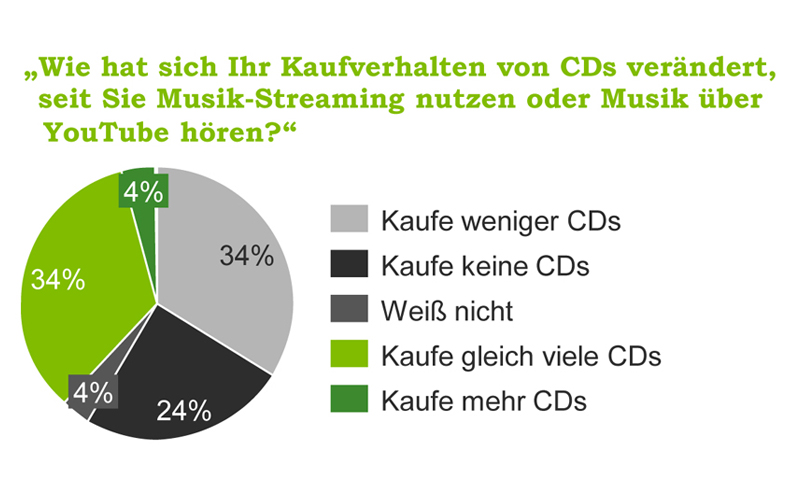
Escucho luego compro, podría decirse que es el resultado de una reciente investigación de mercado en la que se muestra que los servicios de streaming lejos de alejar a la gente de comprar CD's o medios físicos la incentiva a comprarlo, por lo pronto esto sucede en Alemania y según la firma de investigación de mercados Deloitte:

 http://www2.deloitte.com/de/de/pages/technology-media-and-telecommunications/articles/media-consumer-survey-2016.html


La pregunta plantea:

¿Cómo ha cambiado su comportamiento de compras en torno al CD desde que empezó a escuchar música a través de servicios de streaming o de Youtube?

34% compran menos CD
24% No compran CD
4% no sabe
34% compran el mismo número de CD
4% compran más CD


Otro CD mejorado UHQCD... al que la industria seguramente ignorará

UHQCD de la compañía japonesa Memory Tech. ¿Cuantos van con este? ¿Unos 4 a 6 modos mejorados de CD que la industria musical no toma en consideración por que prefiere el lucro con las nuevas tecnologías (streming) o con las viejas (LP)? Me parece que hay algo de manipulación. Hemos visto recientemente varios tipos de CD mejorado, SACD y hasta Bluray para audio pero no permean en el mercado por que la industria no los promueve.

[Image: fig-02_eng.png]

SHMCD, Bluspec, HDCD, XRCD ¿Cuantos más para que presten interés a uno de forma masiva?

Algunas de sus características. Escencialmente mejor material y mejor proceso de manufactura. Y algunos "eruditos" s emofaban de los tratamientos para mejorar al CD que al final resultan muy parecidos a estas nuevas mejoras. Así pasa muchas veces con quienes pretenden parecer listos pero ...

Me llama la atención la mención a un mejor modo de producción y coincide con lo que ya hemos comentado antes y experimentado: Copiar un LP a CD resulta en una copia casi indistinguible entre ese CD y LP pero muchas veces esa copia suena mejor que el CD de fábrica por que el proceso de grabación es más controlado que en una fábrica donde es una impresión.
  • Discs conform to the CD specification and are playable on existing Audio CD players.
  • Master audio is reproduced more faithfully compared to existing high-quality CDs, thanks to a newly developed disc manufacturing process.
  • Newly developed disc manufacturing process masks the sound quality of UHQ CD closer to the master quality compared to existing high-quality CDs
  • Offers easy enjoyment of high-quality audio at a quality that is very close to that of Crystal Disc.


Mejor material translúcido. Jaja, vengaza. ¿Recuerdan como algunos se burlaban sobre tratamientos para CD que mejoraban la transparencia del disco? Bueno si eso hubiese sido tontería estas versiones mejoradas de CD, todas, no estarían mejorando ese aspecto. Por eso aunque muchas veces argumenten mejor tampoco crean todo de los hombres de laboratorio que muchas veces pasan por alto aspectos casi obvios a menso que monten todo un show de evaluación.

Quote:We developed our conventional high-quality Audio CD discs through an effort to improve audio quality by simply upgrading the materials used in ordinary CD discs to higher quality materials. For example, for the substrate we used a high-transparency and high-fluidity polycarbonate (a type of plastic) of the type used for LCD panels, while for the reflective layer, we replaced low-cost, common aluminum with a unique and expensive alloy of high-reflectivity. These improvements made it possible for mass-produced CD discs to reproduce audio with greater precision. In fact, HQCD discs were used to release a wide range of classical and jazz music titles. The approach of upgrading raw materials is limited, however. To achieve further improvements in audio reproduction, we had to totally rethink the disc manufacturing process itself.


[Image: fig-01_eng.png]

¡ Si lo puedo escuchar ! ¿Por qué no puedo medirlo?

Test and Measurement: “I Can Hear It. Why Can’t I Measure It?”

http://audioxpress.com/article/Test-and-Measurement-I-Can-Hear-It-Why-Can-t-I-Measure-It-.html

by Dan Foley

“I Can Hear It. Why Can’t I Measure It?” is the title of an excellent article written by Dan Foley from Audio Precision for audioXpress Focus on Test & Measurement Special issue, March 2016. Dan Foley discusses how audible distortion can be difficult to measure and explores the instrumentation noise floor’s impact on what can be measured. As he explains, instrumentation noise floor is an overlooked contributor for the reason we are not able to measure a particular audible “distortion,” especially with low sound pressure level (SPL) signals.


In many cases, the reason given as to why a particular audible “distortion” cannot be measured is that the measurement equipment doesn’t have sufficient signal processing capabilities, such as measurement bandwidth or Fast Fourier Transform (FFT) resolution. In this article, we will explore an overlooked contributor — the instrumentation noise floor, which can have a significant impact on what can be measured, especially with low sound pressure level (SPL) signals.

Prior to headphones and insert earphones (earbuds) becoming the common way to listen to music, background noise from household appliances or heating and air conditioning fans in a typical listening environment could potentially mask playback system distortion, such as higher order harmonics of AC line hum or switching amplifier intermodulation distortion (IMD).
 
Figure 1: This is the noise criterion (NC) curve for a typical suburban home.[1]
Figure 2: The background sound pressure level (SPL) for my living room is shown.

Typical suburban homes have background noise levels of 30 to 38 dBA, with a noise spectrum corresponding to the Noise Criterion (NC) 30 curve (see Figure 1). Apartment noise levels are even higher.higher. To confirm this, I measured the background noise in my living room and positioned a G.R.A.S. 0.5” microphone (Model 46AE) on a tripod at ear height, and used an Audio Precision APx515 analyzer to measure the corresponding background noise, using a 64k FFT with eight linear averages. The APx Octave Band Utility was used to synthesize an octave-band spectrum. The overall sound pressure level was 38 dBA and the measured ambient noise spectrum just exceeds the NC-30 noise criterion curve by about 1 dB (see Figure 2).

However when one listens to music using circumaural headphones or insert earphones, the listening environment background can be attenuated by 20 dB or more, dramatically reducing the masking that was present due to background noise (see Figure 3). As a result, the listener’s perception during very quiet passages more closely follows the threshold of the hearing curve, shown as a red line in Figure 4, bringing sensitivity to a sound pressure level (SPL) below 0 dB (20 micropascals). From a headphone/headphone preamplifier system perspective, this means that distortion artifacts could be as low as 0 dBSPL and still be audible.
 
Figure 3a: Attenuation graphs are displayed for Circumaural[2] headphones.
Figure 3b: Attenuation graphs are displayed for Insert Earphones[3].
Figure 4: Masking for 1 kHz narrowband noise is shown at various sound pressure levels[4].

Impact On Measurements
So how does all of this impact measurements?
Every part of the measurement signal path introduces noise, beginning with the microphone capsule and its corresponding preamplifier. The IEC 711 couplers that are used in Head-and-Torso Simulators (HATS) test manikins and equivalent products typically incorporate a 0.5” microphone with a 12.5 mV/Pa sensitivity or −38 dB referenced to 1 pascal.

Given that 1 pascal is equivalent to 94 dBSPL, the lowest SPL one can potentially hear around 3.2 kHz is −5 dBSPL. At 94 dBSPL the voltage from the microphone is 12.5 mV. At −5 dBSPL, the voltage level will be 99 dB below this value, which is 141 nanovolts!

Instrumentation noise should be 10 dB below the level one wants to measure. In this case, the noise level in this frequency range would need to be 47 nanovolts, but it does not mean the instrumentation noise floor over the entire audio band needs to be 47 nanovolts. But, the lower the noise floor is from 20 Hz to 20 kHz, the better you can measure these extremely low voltages.
 
Figure 5: The APx515 noise floor is compared to the sound card noise floor.

Figure 5 shows how the instrumentation noise floor can mask the presence of audible signals in the 2-to-5-kHz range. Two pieces of test equipment are compared: the Audio Precision APx515 analyzer and a high-end sound card representative of those often recommended as a data acquisition front-end.

The measurements were obtained using the Audio Precision APx555’s analog generator, which has typical THD+N of −120 dB or better from 20 Hz to 20 kHz. A 1 mVRMS sine wave at 1 kHz was used as the stimulus for both the ADC of the APx515 and the sound card interface. A 1 mV level was chosen because it represents 72 dBSPL when using a 12.5 mV/Pa microphone. For both the APx515 and the sound card interface, 20 linearly averaged 64k FFTs were used to generate the noise-floor spectrum.

The black curve represents the threshold of hearing. The red curve shows the noise floor of the sound card. The blue curve is that of the APx515. It can be clearly seen that when using the sound card interface, sound energy that is audible in the 2-to-5-kHz region may not be measurable. One can increase the FFT buffer size, which in turn will reduce the noise energy in each FFT bin, but this will increase test time.

Results
The ear - especially when little or no acoustic masking is present - is an extremely sensitive “microphone.” Distortion artifacts, such as intermodulation distortion (IMD) and/or pulsating noises (e.g., GSM interference) may be audible even though the actual sound pressure is below 0 dBSPL. Unless the test equipment (in particular the analyzer front-end) has a very low noise floor, there is a risk of not being able to objectively quantify (or develop a proper engineering solution for) distortion that is clearly audible in earphones.


References
[1] “Noise Criterion,” The Engineering ToolBox,
www.engineeringtoolbox.com/nc-noisecriterion-d_725.html.

[2] Audeze LCD-XC Headphone Measurements, Inner|Fidelity,www.innerfidelity.com/images/AudezeLCDXC.pdf.

[3] Shure SE535 Headphone Measurements, Inner|Fidelity,
ww.innerfidelity.com/images/ShureSE535.pdf.

[4] G. Martin, Introduction to Sound Recording, 2011,www.tonmeister.ca/main/textbook/intro_to_sound_recordingch6.html.

Sources
APx515 analyzer Audio Precision | www.ap.com

Model 46AE 0.5” microphone G.R.A.S. Sound & Vibration A/S | www.gras.dk


About the Author
Dan Foley has been with Audio Precision since the middle of 2011. He is an experienced sales engineer with a background that includes 12 years as a sales engineer and US Manager of the Environmental Noise Group for Brüel & Kjær, six years as VP of Sales at Listen, Inc., and five years at Bose Corp. He is an expert in the field of acoustics and has extensive experience with audio-related standards committees, including those associated with the The Institute of Electrical and Electronics Engineers (IEEE), the Audio Engineering Society (AES), and Bluetooth Special Interest Group (SIG) organizations.

Y en Japón... formatos mejorados de CD y SACD... ironías.


En Japón no pierden el tiempo, no discuten y si teorizan es sobre como hacer algo, no sobre como manipular le mercado. Acabo de entrar a ver que había de nuevo en CD Japan y descubro todos estos formatos, unos ya conocidos, otros nuevos y otros ya en su segunda versión.


CDJapan

http://blog.image-src.com/wp-content/uploads/2012/07/MP900305748.jpg
En occidente no salimos aún de los nocivos efectos de la década perdida del MP3 y vamos sin embargo adentrados ya en otra etapa de nebulosidad y desconocimiento de la mano de la "revivida" analógica del LP así como lo venden hoy día para extraviados o por otro las del supuesto HD Audio y sus virtudes bastantes veces ya cuestionadas.


  • Platinum SHM-CD
  • SHM-SACD
  • SHM-CD
  • Blu-spec CD2
  • Blu-spec CD
  • HQCD (HiQualityCD)

Además de SACD

SHM-CD: https://en.wikipedia.org/wiki/Super_High_Material_CD
Blu-spec: https://en.wikipedia.org/wiki/Blu-spec_CD
HQCD: http://hqcd.jp/hqcd_eng/


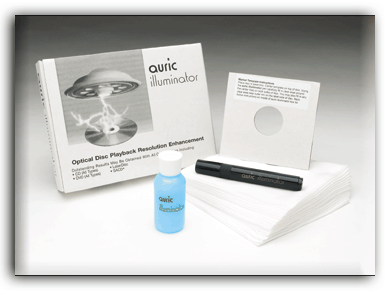
http://www.tnt-audio.com/gif/auric.gif¿Lo irónico?  Pueden ver que mucho se trata de mejorar la calidad del material que sea lo más transparente posible así como la capa reflejante. ¿Recuerdan cuando muchos sesudos atacaban y se burlaban de tratamientos como Last, Auric Illuminator, Audiotop, Walker y más? Todos esos productos apuntaban a lo mismo, a mejorar y optimizar las condiciones ópticas del material.
Por eso digo muchas veces que aunque parezcan inteligentes esos "sesudos" mejor no los escuchas, muchas veces solo son un costal de prejuicios y zonas cómodas del saber.

80,000 tocadiscos vendidos en Alemania en el 2015


Im vergangenen Jahr sind in Deutschland rund 80.000 Plattenspieler verkauft worden. Sie haben einen Umsatz von 15. Mio. Euro generiert, wie die gfu, Gesellschaft für Unterhaltungselek- tronik, meldet. Das entspricht einem Durchschnittspreis von 188 Euro pro Gerät. Für dieses Jahr erwartet die gfu eine noch höhere Stückzahl bei sogar steigendem Durchschnittspreis. Jenseits der Diskussion um die klanglichen Vorteile der Vinylplatte sieht die gfu den „Wunsch vieler stressgeplagter Menschen nach Entschleunigung“ als Grund für die wachsende Beliebtheit der Schwarzen Scheibe.


2015: Formatos y ventas de música

Ya están los números del 2015 para EUA.


Hecho, la gente ahora prefiere una especie de radio bajo pedido con la proliferación de servicios de "streaming" "¡Que avance!"

Los medios físicos están acorralados

Al LP lo siguen alabando como resurgido y al CD com muerto viviente, sin embargo el LP no es ni la décima parte de lo que el CD representa en el mercado, esto solo por las dscontextualizadas cifras de crecimiento año a año.

Si vamos a revivir a alguien basándonos en cifra de crecimiento en ventas año a año entonces recibámos al Lázaro del 2015 : el SACD. Así es el SACD vió un crecimiento tanto en número de unidades vendidas como de aumento de ingresos de un 40% redondeado... y nadie lo elogia como al LP.

¡Ah que cosas de mercado y manipuleos mediaticos!


Questyle CMA600i manteniendo el estándar

Questyle ha presentado el CMA600i, una versión  escancial de su estupendo CMA800i, DAC PCM/True DSD, amplificador de audífonos, pre de linea con circuito independiente y control de volumen motorizado, todo en un bello y bien resuelto aparato. Precio en México 1450 USD. (www.armonia-av.com)


Questyle Audio Unveils New Premium Integrated DAC And Amplifier Combo At Canjam 2016


by audioXpress Staff

 
Amplification and High Resolution Audio specialist Questyle Audio announced the CMA600i DAC-headphone amplifier, the newest addition to their premium audio systems at the CanJam SoCal 2016 event in Costa Mesa, California. The CMA600i is a more affordable version of their CMA800i, the integrated all-in-one DAC and Current Mode headphone amplifier and pre-amp, which inherited the patented current mode topology of the original Questyle CMA800 amplifier.

After many long hours of debugging, the CMA800, the world’s first Current Mode headphone amplifier, was born in 2007. CMA is short for Current Mode Amplification, whose THD+N is 0.0004%, and whose TIMD is so ultra low that it can hardly be tested. The CMA800 was the first Current Mode amplifier to be mass produced with excellent and stable performance and propelled Jason Wang’s company - Questyle Audio - all over the world.

The new Questyle Audio 600i DAC-headphone amplifier combo, is also a perfect complement to the company’s QP1R HRA portable music server / digital audio player, as well as their new 7.1 channel 5GHz Wireless Amplifier system, also demoed at CanJam 2016. Questyle unveiled the new CMA600i in partnership with Westone and Enigma Acoustics while the Questyle wireless system was driving the amazing ENIGMAcoustics M1 Mythology Hybrid electrostatic speaker system.

“Following the enthusiastic embrace of high resolution music and high-end headphones, consumers have flocked to Questyle Audio’s high-end components” says Bruce Ball, Vice President of Questyle North America. “The company’s new 600i integrated DAC/Amp combo creates excellent value by providing a high-end combo solution at a more modest price point. Meanwhile, Questyle is hard at work fine-tuning every aspect of our desktop system to create the new Gold Reference Edition for the audiophile who simply wants the best performance possible,” added Ball. 
 

The Questyle Audio CMA600i Integrated Desktop DAC with Headphone Amplifier leverages Questyle’s patented Current Mode headphone amplification technology and uses a USB port that adopts a unique 3X Clock structure. This ensures a proper sync with the premium AK4490 32-bit DAC chipset from AKM. The chipset includes a newly developed switch capacitor filter “OSR Doubler” that greatly reduces sound degradation from noise shaping, achieving a flat noise floor up to 200kHz. The AK4490 chip obtains first class sound performance by also reducing jitter and pre-ringing to undetectable levels. The CMA600i also features a 4-pin balanced XLR stereo headphone output, accommodating balanced headphones with a single integrated DAC/headphone amp. The CMA600i is also equipped with XLR and RCA pre-amplifier outputs that support 24bit/192KHz transmission to a separate power amplifier, such as the new R200i wireless / wired amplifiers that accommodate balanced connection, and allows the CMA600i to act as a separate, premium DAC/Preamp. The CMA600i is available in Space Gray now for $1,299.


El smartphone más audiófilo con DAC dual mono ESS Sabre


X5Pro


Vivo, una desconocida compañía de la India, no SONY, ni Samsung mucho menos Apple, ha preentado un teléfono con doble DAC (en modo dual mono) implementando los muy reconocidos ESS ES9028 SABRE, lo que lo hace único en su tipo. El modelo es VIVO Xplay5 Elite.

Algunas notas al respecto:


"The ES9028 SABRE DAC is a high-performance 32-bit digital to analog converter and uses ESS’s patented 32-bit HyperStream architecture and Time Domain Jitter Eliminator. It is the first SABRE DAC to use ESS’s new internal dual-DAC architecture to further enhance performance. It also delivers an unprecedented dynamic range (DNR) of up to 129dB and total harmonic distortion plus noise of -120dB (THD+N) – a technical performance level that will satisfy the most demanding audio enthusiasts while still delivering the superb sound experience SABRE products are known for."

HD vinyl: el formato que revolucionará el mercado: LP del siglo XXI


hdvinyl1


HD vinyl: el formato que revolucionará el mercado


Por fin a alguien se le ocurrió un LP de la era digital, pero al servicio de lo analógico.
Proponen un nuevo tipo de LP, lo mejor es que sería compatible con las actuales trnamesas, tendría 30%  más capacidad y tendría  una mejora de 30% de rango dinamico. Muy interesante.


En el audio algunas cosas nunca cambian, así en 1958 como en 2016


https://s-media-cache-ak0.pinimg.com/736x/17/48/1e/17481ee71a8ba2a7b1e2fdcf76f4ce99.jpg


In Audio Some Things Never Change


Primer número de Hi-Fi & Music Review que sería luego Stereo Review, febrero de 1958 y ya entonces planteaban estas 12 preguntas fundamentales para quien quiere conformar un sistema de audio. Válidas ayer, válidas hoy.


  1. What do you want your system to do? ¿Qué espera que haga su sistema?
  2. What kind of music do you prefer? ¿Qué tipo de música prefiere?
  3. Do you like your music loud or soft? ¿Prefiere escuchar a volumen alto o bajo?
  4. Do you listen alone? Concentrate on listening? Use music mostly for background? Live in a quiet neighborhood?, Live in a noisy city neighborhood?, Think your hi-fi will disturb apartment neighbors? ¿Escucha usted solo? ¿Se concentra en la escucha? ¿Usa la música principalmente como fondo? ¿Vive en un vecindario silencioso? ¿Vive en un vecindario ruidoso? ¿Cree que su sistema de Hi-Fi puede molestar a sus vecinos del edificio?
  5. What is the decoration scheme in your living room? ¿Qué tipo de decoración tiene en su sala?
  6. What are your room dimensions? ¿Cuales son las dimensiones de su habitación?
  7. Does your room have a lot of sound absorbing furniture? ¿Tiene su habitación bastante mobiliario que absorva el sonido?
  8. How do you want your equipment installed? Hidden, exposed, or conveniently placed? ¿Como quiere su sistema instalado? ¿Oculto, expuesto o en un lugar adecuado?
  9. What is preference in operating methods? ¿Cual es su preferencia de operación?
  10. Is your equipment in danger of exposure to: Children? Technically awkward friends or relatives? ¿Está su sistema en peligro de exposición con niños o amigos o familiares con problemas de operación de cosas técnicas?
  11. Will this Hi-Fi purchase be your first? Last? Gradual improvement? Most perfect you can get? ¿Será esta su primer compra de HiFi? ¿Será la última? ¿Está en mejora gradual? ¿Busca comprar lo mejor que sea posible?
  12. How much do you want to spend? (Which the editor labeled "and last but most important of all.") ¿Cuanto desea usted gastar en ello? (QUe el editor marcó como "y al último pero lo más importante de todo")
http://audiophilereview.com/audiophile/even-in-modern-audio-some-things-never-change.html

:


  1. What do you want your system to do?
  2. What kind of music do you prefer?
  3. Do you like your music loud or soft?
  4. Do you listen alone? Concentrate on listening? Use music mostly for
    background? Live in a quiet neighborhood?, Live in a noisy city
    neighborhood?, Think your hi-fi will disturb apartment neighbors?
  5. What is the decoration scheme in your living room?
  6. What are your room dimensions?
  7. Does your room have a lot of sound absorbing furniture?
  8. How do you want your equipment installed? Hidden, exposed, or conveniently placed?
  9. What is preference in operating methods?
10. Is your equipment in danger of exposure to: Children? Technically awkward friends or relatives?


11. Will this Hi-Fi purchase be your first? Last? Gradual improvement? Most perfect you can get?


12. How much do you want to spend? (Which the editor labeled "and last but most important of all.")

- See more at: http://audiophilereview.com/audiophile/even-in-modern-audio-some-things-never-change.html#.dpuf
  1. What do you want your system to do?
  2. What kind of music do you prefer?
  3. Do you like your music loud or soft?
  4. Do you listen alone? Concentrate on listening? Use music mostly for
    background? Live in a quiet neighborhood?, Live in a noisy city
    neighborhood?, Think your hi-fi will disturb apartment neighbors?
  5. What is the decoration scheme in your living room?
  6. What are your room dimensions?
  7. Does your room have a lot of sound absorbing furniture?
  8. How do you want your equipment installed? Hidden, exposed, or conveniently placed?
  9. What is preference in operating methods?
10. Is your equipment in danger of exposure to: Children? Technically awkward friends or relatives?


11. Will this Hi-Fi purchase be your first? Last? Gradual improvement? Most perfect you can get?


12. How much do you want to spend? (Which the editor labeled "and last but most important of all.")

- See more at: http://audiophilereview.com/audiophile/even-in-modern-audio-some-things-never-change.html#sthash.tOq0PZ2L.dpuf

La historia del audio high end

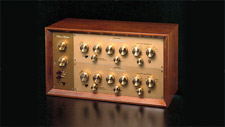
High-End-History-Marantz-Audio-Consolette.jpgThe History of High End Audio

 Muy interesante artículo

Reportes 2015 sobre venta de música en Alemania y EUA

EL CD no está muerto, llevan 10 años matándolo para negocio de disqueras, hipsters, lo que sea. Aun detenta entre el 49% y 52% del mercado en USA y en Alemania alrededor del 60%.

El LP lo reviven y reviven ¿Y cómo no? Si venden los platos negros a precios absurdos, aún así llega a alg como el 5.5% en EUA y un 3.5 en Alemania.


Alemania: http://www.musikindustrie.de/aktuell_einzel/news/deutscher-musikmarkt-schliesst-2015-mit-einem-plus-von-46-prozent-ab/


EUA: http://www.musicbusinessworldwide.com/us-album-sales-fall-4-in-first-half-of-2015-as-cd-rules-market-just/

AlbumsUs2015

Goldkabel Executive LS 425 Bi-Wire Rhodium cosechando reconocimientos.

Goldkabel Executive LS 425 Bi-Wire Rhodium


Este fabricante de cable para audio de altas prestaciones ha venido cosechando reconocimientos, su nuevo LS425 Rhodium BiWire en un par de meses ha tenido dos excelentes recomendaciones por parte de las publicaciones Heimkino y HiFiTest.de En México www.armonia-av.com lo promueve y representa.


El más reciente en HiFiTest.de : http://www.hifitest.de/test/lautspreche ... dium_11520


(Fazit) Conclusión

El Executive LS 425 Bi-Wire Rodio de Goldkabel es una verdadera recomendación para amantes de la música sofisticados que ponen más énfasis en la verdad, la calidad del producto verificable que en paisajes sonoros "esotéricas" de los cables más caros. Esta referencia de clase-Bi-WireCables de altavoces "cosquillas" por la calidad de sonido máxima desde cualquier altavoz audiófilo - una verdadera atracción!


Y Heimkino: